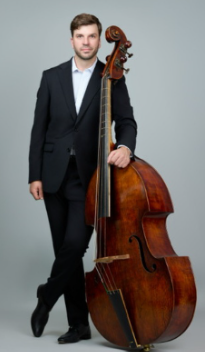
A native Charlottean, artistic administrator and double bassist Peter Ferretti enjoys a varied career spanning multiple continents, industries, and genres.
For the past 7 years, Ferretti has managed the orchestral operations for Teatro Nuovo, a historically-informed opera company based in New York City. Ferretti began his tenure with the company as orchestra manager, and currently serves as the institution’s Director of Orchestra Operations as well as its principal double bass. Considered one of the leading institutions in the United States focused on romantic-era performance practice, the orchestra of Teatro Nuovo has been hailed by the New York Times as “astonishing,” by The New Yorker’s Alex Ross as having played “fiercely and flavorfully,” and by Opera Wire as “as near flawless as can be.” Ferretti has also served as the Executive Director of watermark: a period instrument ensemble, an ensemble dedicated to bringing the repertoire of the pre-romantic era to audiences traditionally underserved by historically informed performance practice. Ferretti currently serves the Salisbury Symphony Orchestra as its Executive Director.
A double bassist by training, Ferretti has played with many of the world’s leading chamber orchestras and historically informed ensembles. Since 2019, Ferretti has worked regularly with Jordi Savall and Le Concert des Nations, appearing on the orchestra’s acclaimed recordings of the symphonies of Beethoven, Mendelssohn, Schubert, Schumann, Bruckner, and others. Ferretti is also a regular guest of the Deutsche Kammerphilharmonie Bremen, with whom he has also toured and recorded extensively, appearing most recently on the orchestra’s recordings of Haydn and Mozart. Elsewhere in Europe, Ferretti’s principal bass commitments include performances with Les Musiciens du Louvre, Concerto Köln, Le Cercle d l’Harmonie, Orchestre Révolutionnaire et Romantique, Eroica Berlin and regularly appears as a substitute with Ensemble Resonanz. In the United States, he can regularly be seen performing with the Handel + Haydn Society and Boston Baroque.
Ferretti holds a B.M. from New England Conservatory, where he studied with Don Palma, an M.M. in historical bass from The Juilliard School, where he studied the various historical bass instruments with Rob Nairn and G-violone with Heather Miller Lardin, and an M.A. in International Relations from Utrecht University, an institution from which he graduated cum laude, and has worked for the Stiftung Wissenschaft und Politik in Berlin, working as a research intern in the Americas Research Division.
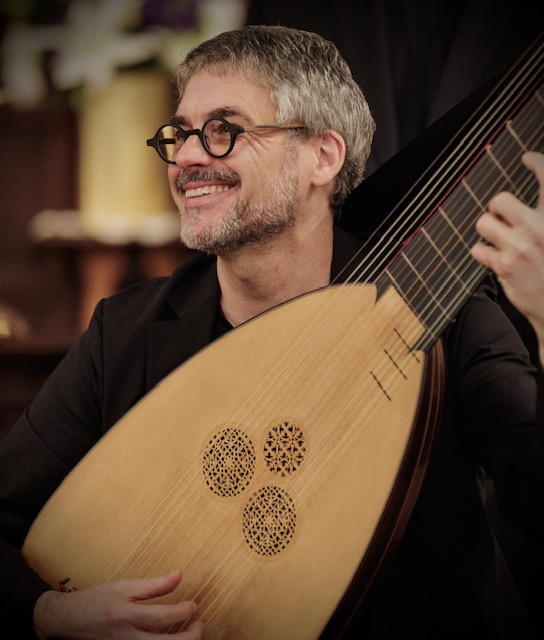
Daniel Swenberg
Daniel Swenberg specializes in Renaissance and Baroque lutes, theorbos, Baroque and 19th-century guitars, and Baroque mandolino. He has performed regularly throughout North America with many leading ensembles and artists including Artek, Rebel, the Metropolitan Opera, the Carmel Bach Festival, Mr. Jones and the Engines of Destruction, Ensemble Viscera, Opera Atelier/Tafelmusik, Catacoustic Ensemble, the Four Nations Ensemble, Apollo’s Fire, the Handel and Haydn Society, the Green Mountain Project, Tenet, Skid Rococo, the Newberry Consort, Lizzy & the Theorboys, Music of the Baroque, the Aspen Music Festival and the Orchestra of St. Luke’s, and in recital with Renée Fleming and Kathleen Battle at Carnegie Hall. He received awards from the Belgian American Educational Foundation (2000) for a study of 18th-century chamber music for the lute, and a Fulbright Scholarship (1997) to study in Bremen, Germany, at the Hochschule für Künste (studying with Stephen Stubbs and Andrew Lawrence King). He studied previously with Patrick O’Brien at Mannes College of Music, where he received a master’s degree in Historical Performance (Lute). Swenberg has been a Juilliard faculty member since 2014.
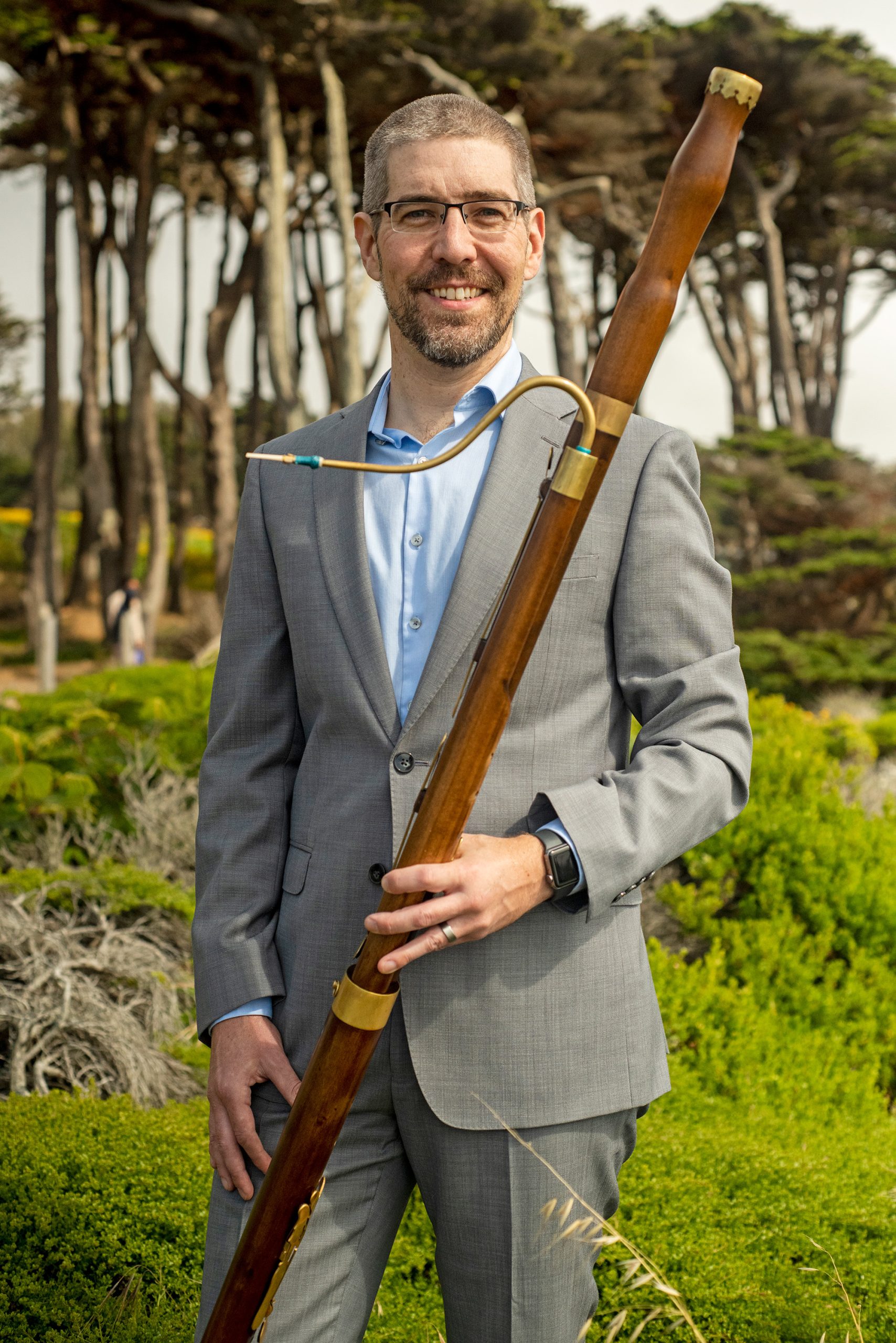
David Wells
Dr. David A. Wells enjoys exploring the richness of the bassoon’s past as well as forging new paths for the instrument’s future. He specializes in historically-informed performances on 17th – 20th century period bassoons, playing regularly with ensembles such as the Carmel Bach Festival, American Bach Soloists, Sinfonia Spirituosa, and Philharmonie Austin. He is also adept on the modern bassoon and contrabassoon, equally at home with standard orchestral/chamber/solo repertoire and demanding modern works involving extended techniques or electronics. In addition, Wells relishes taking the bassoon to unexpected places, most notably having spent nine years with a Django Reinhardt-inspired swing sextet. Since Fall 2023, Wells has been Assistant Professor of Bassoon at Appalachian State University, where he also teaches music history. Prior to coming to North Carolina, he taught for a dozen years at Sacramento State University in California. Wells also serves as Co-Executive Director of Meg Quigley, an organization devoted to making the bassoon world more diverse, equitable, inclusive, and supportive. When not playing or teaching, he can be found swimming, taking photographs, collecting records, and trying to keep up with his super-librarian/yogi wife, Veronica.
Dr. Wells holds both a D.M.A. in Bassoon Performance and an M.A. in Musicology from the University of Wisconsin-Madison, an M.M. in Bassoon Performance from Florida State University, and a B.M. in Bassoon Performance from Arizona State University.
Link: https://davidawells.com/
Stephanie Vial
Baroque & Beyond’s artistic director, Stephanie Vial, is a widely respected cellist, praised for her technical flair and expressive sense of phrasing. She is a co-director of The Vivaldi Project (based in Washington, DC) with whom she developed the recording series Discovering The Classical String Trio (MSR Classics) hailed by Gramophone as “captivating” and “highly recommended.” Additional recording can be found on the Dorian Label, Naxos, Hungaroton, and Centaur Records. She has traveled widely, giving solo and chamber music concerts, lectures, and master classes at numerous universities and institutions: The Shrine to Music Museum in South Dakota, The University of Virginia, Boston Conservatory, McGill University, and The Curtis Institute of Music. Vial holds a DMA in 18th-century performance practice from Cornell University where she studied with John Hsu. She is the author of The Art of Musical Phrasing in the Eighteenth Century: Punctuating the Classical “Period,” published by the University of Rochester Press. She currently teaches at the University of North Carolina at Chapel Hill and Duke University.
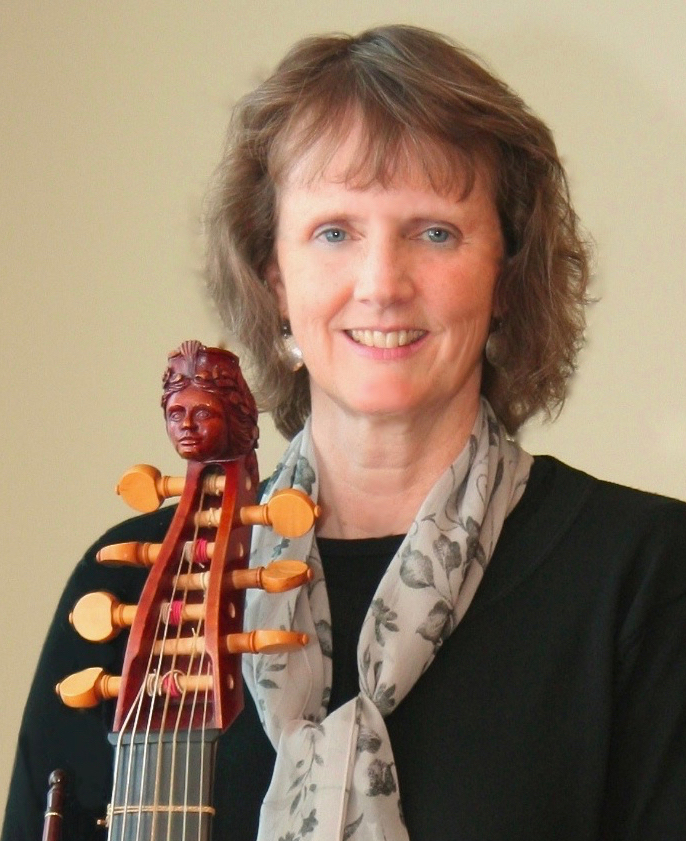
Gail Schroeder
Gail Ann Schroeder studied viola da gamba at the Royal Conservatory of Brussels with Wieland Kuijken, obtaining her First Prize and Higher Diploma, with distinction. She subsequently taught viola da gamba, pedagogy and directed the viol consort at the Brussels Conservatory from 1988 to 2002.
Gail has had an extensive career as soloist and as chamber musician, concertizing and recording with various ensembles such as the Huelgas Ensemble, Combattimento Consort Amsterdam, Ricercar Consort, Currende Consort, Capilla Flamenca, and Catacoustic Consort. She has performed in many of the European Festivals including Holland Festival Oude Muziek in Utrecht, Resonanzen, Innsbrucker Festwochen, Les Académies Musicales de Saintes, Festival van Vlaanderen, Festival de Wallonie and Internationale Festtage Alter Music Stuttgart.
Since returning to the USA in 2006, Gail has been in demand as a teacher and ensemble coach at workshops for the Viola da Gamba Society of America, the Amherst Early Music Festival, Madison Early Music Festival, Music on the Mountain, Retreat to Advance and Mountain Collegium, where she is assistant director and head of the viol program. Currently living in North Carolina, she teaches privately and is artistic director of Asheville Baroque Concerts.
Gail Ann Schroeder’s website
In collaboration with Asheville Baroque, the program explores the range and capabilities of Baroque bass instruments—viola da gamba, cello, violone, and bassoon—featuring each in solo works and various ensemble combinations. This is a pay-as-you-can event, but please consider supporting Baroque & Beyond with a season subscription or ticket donation.
Read more in CVNC, the Classical Voice of North Carolina
Gail Ann Schroeder, viola da gamba Stephanie Vial, cello Peter Ferretti, violone David Wells, bassoon Dan Swenberg, theorbo, Baroque lute & archlute
Works include: Girolomo Frescobaldi’s Canzon à due Bassi Theodor Schwartzkopff‘s Sonata à 3 in g minor for gamba and bassoon Carl Friedrich Abel‘s Duo on G major for gamba and cello Benedetto Marcello‘s sonata in C minor for two gambas or two cellos Michel Corrette‘s Concert ‘Le Phènix’ as well as solo works by J.S. Bach, Giovanni Battista Vitali, Jean-Daniel Braun, Christopher Simpson, and S.L. Weiss
A little preview of the 5 string cello, a Gavotte from Suite 6 in D major by J.S. Bach